Own what AI tools say about your business
They already answer questions about you. The details come from somewhere, and it might not be your website. This upgrade makes your site the clearest and most current source available.
It's not that AI can't find you. It's what it says when it does.
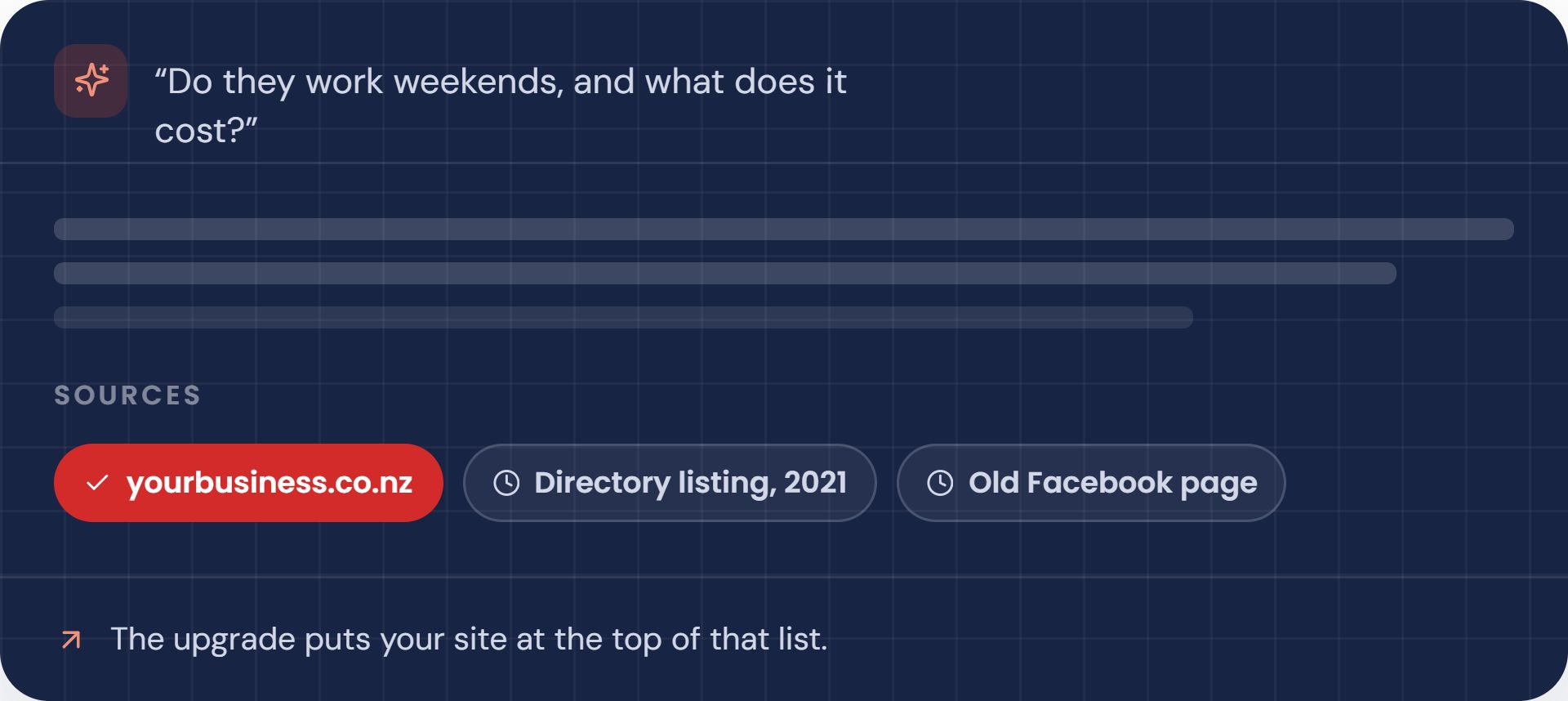
Ask ChatGPT, Claude, Copilot or Gemini about your business by name and you'll probably get an answer. That's the easy part. The question worth asking is where the answer came from.
It might be your website. It might be a directory listing from four years ago, a Facebook page you stopped updating, or a description someone else wrote about you. If your services have changed, your hours have moved or you've dropped a product line, the version out there may still be the old one.
Being right isn't enough on its own. We have seen a business publish the correct prices on its own website while a directory carried a different set of numbers for the same service, and the directory's version was the one that kept surfacing. Your information can be accurate and still not be the version people find.
This upgrade makes your site the easiest, clearest and most current thing for those tools to read, so what gets said about you comes from you.
Everything your site needs to be the source
Business details in a readable format
Your services, location and opening hours written into your site as structured data, so search engines and AI tools read them directly instead of piecing them together from elsewhere
Titles and summaries refreshed
We check your page titles and meta descriptions still match what customers search for, and rewrite any that have drifted
Tidier page headings
A clean heading order on every page, so search engines and AI tools can follow your content
FAQ sections on your service pages
A reusable FAQ block added to each service page. It stays hidden until questions are added, so your pages stay clean until you're ready
FAQs refined and loaded
You send us your questions and answers, we tighten the wording and load them onto your pages. The words stay yours, and we send you a short guide on writing them well
Image labels
Alt text across your images, for search and for people using screen readers
Internal links
Links between related pages, so people and crawlers can both find their way through your site
Social sharing previews
Correct titles, descriptions and images when someone shares your pages on Facebook, LinkedIn or in a message
Technical housekeeping
Sitemap, canonical tags, an llms.txt file and the small technical items that stop a site being read cleanly
A plain summary of what changed
A short rundown of the work, in language you can actually use, plus what to keep an eye on afterwards
Four steps, no fuss
Most upgrades are done within a couple of weeks.
We check what's being said about you now
We ask the AI tools specific questions about your business and record what comes back, including where they got it. This becomes your before picture.
You send us your FAQs
Real questions your customers ask, with your answers. Four to eight per service page. We send you a short guide first, then refine what you write.
We do the work
Structured data, headings, meta tags, FAQs, image labels, internal links and technical setup, all inside your Webflow site.
We hand it back
Your site goes live with a summary of what changed, plus our guide covering the off-site parts only you can do.
We keep the scope clear
So there are no surprises. But if you need any of these, just ask and we'll quote them.
Some of this sits outside your website
Being recommended when someone asks an AI tool for an accountant, plumber or a physio depends heavily on things that don't live on your site. Your Google Business Profile. Your reviews. Whether other websites mention you. We can't do those for you but we can guide you. So we wrote them down. Our free guide covers every off-site step that matters, in order of impact, with what to do and roughly how long each takes. Yours whether you buy the upgrade or not.
We offer Local Search Optimisation to boost your local profile and get found on Google Maps by more potential clients. Reach out to us today if you would like to know more
This upgrade is for Webflow sites
We work in Webflow, and only in Webflow. It gives us direct control over headings, structured data, meta tags and page structure, which is exactly what this work needs. On most other platforms that control sits behind plugins or is locked away entirely.If your site is somewhere else, moving to Webflow is the better fix. You get clean code, fast pages, a site your team can edit without a developer, and hosting, SSL and backups handled. Talk to us and we'll tell you straight if it's worth doing.
Search keeps moving. You can keep up with it.
The upgrade is a one-off job and it stands on its own. But your services change, your hours change, and new customer questions come up. A site that was accurate last year drifts out of date without anyone noticing.
Two ways to stay on top of it, if you want them.
Neither is required. The upgrade works fine on its own.
Six-monthly review
Twice a year we check your titles, summaries and structured data, refresh anything that has drifted, and add new FAQs from the questions you have been getting.
Monthly SEO
Ongoing work on rankings, content and technical health, with regular reporting. This is the option if search is a real channel for your business and you want someone on it every month.
We've been doing this a long time.
Webflow Premium Partner
We build every site in Webflow, the platform trusted by serious businesses worldwide.
25 years of web experience
You're working with people who have done this a long time.
Auckland-based
Real people you can talk to, not a faceless offshore team.
We tell you where the limits are
We build every site so search engines and AI tools can read it properly. We can't promise rankings, but we set you up the right way.
We follow Google, not the acronyms
Google's own guidance says that optimising for AI search is still SEO, and that you should apply scrutiny to anyone selling AEO or GEO services. We agree. This package does what Google actually recommends: clean technical structure, accurate business information and content written for people. The acronym on the tin is just what clients ask us for.
Good questions, straight answers
Good, that means you're findable. Two things worth checking. First, was all of it current? Businesses change services, hours and coverage areas, and the version out there is often the old one. Second, try a specific question instead of a general one. Ask about after-hours work, your exact service area, or what a particular job involves. That's where most answers go vague, because nobody has answered it plainly anywhere.
Not on its own, and we won't pretend otherwise. Unbranded recommendations lean mostly on things outside your website: your Google Business Profile, your reviews, and whether other sites mention you. This upgrade sorts your website, which is the part we control. Our free guide covers the rest, and we'll send it to you either way.
Correct is the starting point, not the finish. Two things still go wrong. A third party can carry a different version of the same information and have it surface ahead of yours, which we have seen happen with pricing. And the summary that appears in search results can contradict the page it points at, so the first thing anyone reads is wrong even though the page itself is right. Both are fixable, and neither shows up until somebody goes looking.
Different names for the same work. GEO stands for generative engine optimisation, AEO for answer engine optimisation, and there are two or three other acronyms doing the rounds. There is no agreed definition separating them, and Google's own documentation says that optimising for AI search is just SEO. We use AEO because it is the term clients ask about. The work underneath is the same either way.
We add one as part of the technical work. Be aware of what it is though. It's a proposed file format that no major AI company has committed to reading, and studies of AI crawler traffic show it barely gets requested. It costs us ten minutes so we include it, but anyone selling it as the thing that fixes AI visibility is overstating.
AEO stands for Answer Engine Optimisation. It means structuring your site so AI tools can read it, understand what your business does, and use it accurately when someone asks a question.
There's a lot of overlap, and the overlap is the point. Structured data, clean headings, accurate meta descriptions and clear answers help conventional Google search as much as they help AI tools. None of this work is speculative.
Some of what gets said about AI is. What we're doing here isn't. Schema, heading structure, internal links, alt text and refreshed meta tags were good practice before AI turned up and remain so. AI raised the cost of getting them wrong.
Fair question. When we built your site, this work wasn't part of a standard build, because AI tools weren't answering questions about businesses and Google read pages differently. That changed quickly. It's now part of every new site we build, and this upgrade brings existing sites up to the same standard.
Probably, and that work still counts. What you paid for was the SEO of the time: page titles, descriptions, sitemap, the fundamentals. This adds the structured data and question-and-answer format that AI tools rely on, which either didn't exist or didn't matter when your site went live.
Maybe not urgently. Ranking well means Google understands your site already. The gap is usually accuracy in AI answers, which lean harder on structured data and often pull from third-party sources. If your Google traffic is healthy, this is about protecting the position rather than fixing a problem.
Word of mouth almost always ends with someone looking you up. When they search your name or ask an AI tool about you, what comes back should be accurate. If the answer is built from a stale listing, that check goes wrong at the exact moment someone is deciding.
Parts of it, if you're comfortable in Webflow. Alt text and gathering FAQ questions are straightforward. Structured data, canonical tags and heading hierarchy get technical fast, and getting them wrong is worse than leaving them alone. The off-site work in our guide is all yours to do though, and it's the part that matters most for recommendations.
We record what the AI tools say about you before we start and again afterwards, so you can see the difference in the answers. Alongside that you should see cleaner results in Google Search Console over the following months. Search takes time, so don't expect overnight movement.
Yes, and that is deliberate. You know what customers ask and you know the answers. We send you a short guide, you write four to eight per service page, and we tighten the wording and load them. The words stay yours, which is how they should read. If you would rather we wrote them from scratch, we can quote that separately.
Yes. Google removed the FAQ dropdowns that used to appear under search results, so FAQs no longer get you that. The value now is answering real customer questions on the page, for your customers and for the tools reading your site. Write them for your customers first.
Four to eight per service page is plenty. A short, real FAQ beats a long, made-up one.
Usually a couple of weeks from when you send us your material.
Only where the FAQ sections appear. Everything else happens in the structure and code behind your pages.
No. Structured data adds a very small amount of code. Everything else is a change to markup you already have.
No. One-off job, fixed price, quoted before we start. The six-monthly review and monthly SEO plan are separate and optional.
It will. That's what the six-monthly review is for. The underlying work doesn't expire though. Clean structure, clear headings and accurate answers have been the right approach through every change so far.
No. We work in Webflow only. If you're on another platform, talk to us about moving across.
Ready to get started?
Make your website the source AI tools use, and get our guide to the parts only you can do.